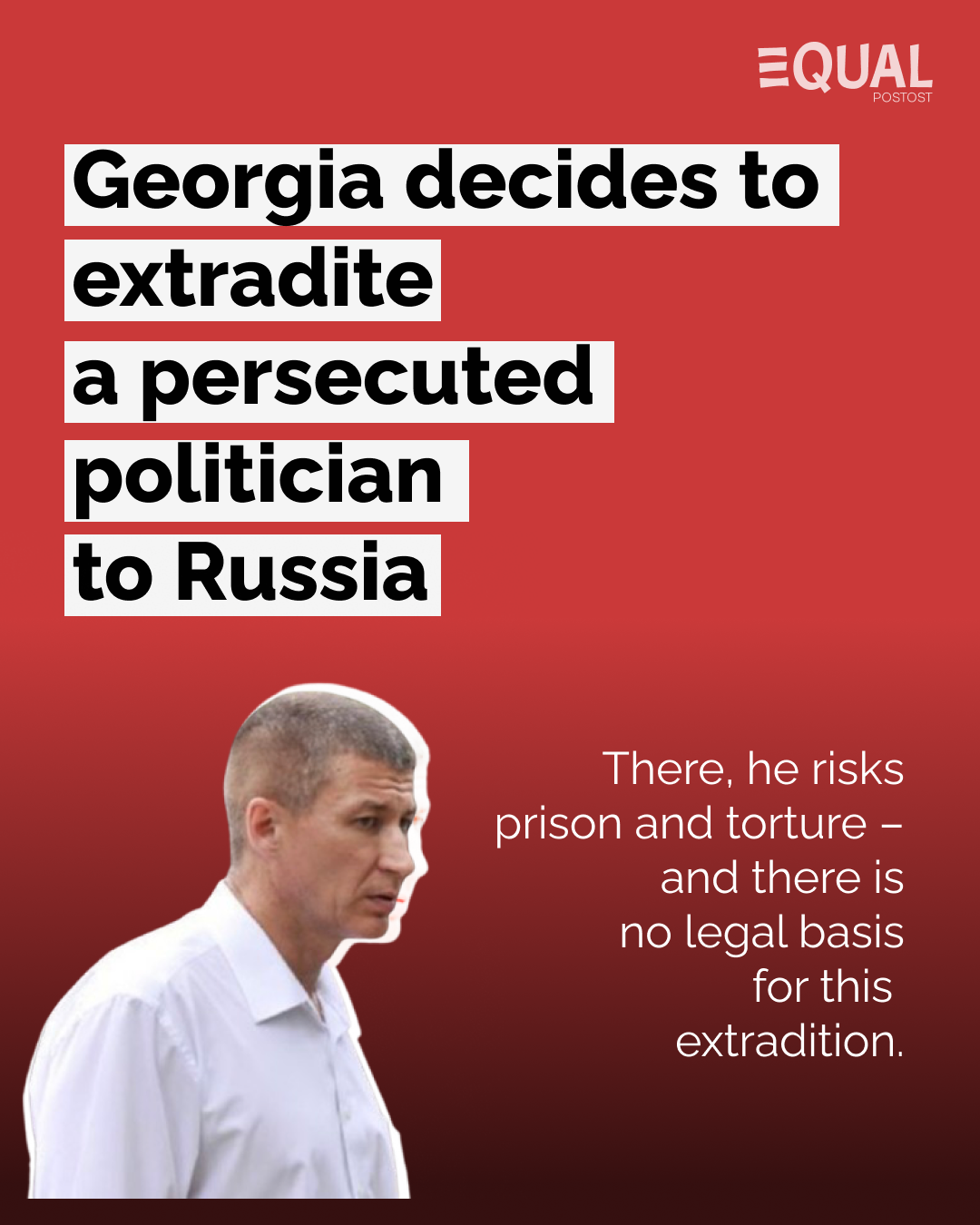
Georgia authorizes the extradition of Mikhail Timofeev to Russia despite the cancellation of his INTERPOL Red Notice and evidence of political persecution
EQUAL PostOst calls on Georgia’s Supreme Court and Ministry of Justice to halt the extradition. This case concerns more than Mikhail Timofeev himself: if the decision remains in force, it will set a dangerous precedent for Russians seeking protection in Georgia from politically motivated criminal prosecution.
On September 4, 2026, the Tbilisi City Court ruled that the extradition of 60-year-old Mikhail Timofeev to Russia was permissible. Timofeev is a former collegue and political associate of Sergei Furgal, the former Governor of Khabarovsk Krai. The defense intends to appeal the decision to the Supreme Court of Georgia.
Of particular concern is the fact that Timofeev’s Red Notice had been deleted from INTERPOL’s system before his arrest in Georgia.
Russian authorities secured the publication of a Red Notice in April 2024. Timofeev’s lawyers challenged the notice, after which it was initially suspended and ultimately deleted from INTERPOL’s system in September 2025.
According to the BBC, as reported by Civil Georgia, the defense submitted INTERPOL documents confirming the cancellation of the notice after the charges brought by Russia were found to be insufficiently substantiated. According to the defense, Georgian authorities were aware that the notice had been cancelled.
Nevertheless, Timofeev was arrested in Georgia on January 23, 2026. The prosecution cited a letter from the Moscow INTERPOL bureau and the Red Notice issued in April 2024 as grounds for his arrest. By that time, the Red Notice had already been inactive for several months.
This is a crucial circumstance. The international law enforcement mechanism has already ceased to support Russia’s request, but Russia is now seeking to achieve the same result through extradition proceedings.
The removal of a Red Notice does not, in itself, legally prevent Russia from submitting a separate extradition request. However, Georgian law expressly prohibits extradition where there are reasonable grounds to believe that the request is being used to prosecute a person on political grounds. It also prohibits extradition where the person would face a risk of torture or inhuman or degrading treatment following extradition.
In Mikhail Timofeev’s case, these risks are not merely theoretical.
The political context of the case is linked to the prosecution of Sergei Furgal, whose arrest sparked months of mass protests in Khabarovsk. Human rights defenders have described the prosecution of Timofeev as politically motivated. Mariana Katzarova, the UN Special Rapporteur on the situation of human rights in the Russian Federation, has also addressed the Georgian authorities regarding the case, warning of the political nature of the prosecution and the high risk of torture if Timofeev were returned to Russia.
Mikhail Timofeev has a Group III disability and suffers from severe chronic illnesses. Moreover, the European Court of Human Rights has already found that Russia violated his right not to be subjected to degrading treatment. In its judgment in Mikhaylov and Others v. Russia of November 10, 2022, the ECHR found a violation of Article 3 of the European Convention in respect of Timofeev because he was held in a metal cage during previous criminal proceedings.
This case goes far beyond one individual.
If Mikhail Timofeev is extradited to Russia despite the cancellation of the international wanted notice, the UN’s position, the ECHR judgment, and the medical evidence, the consequences of this decision will be tragic.
For thousands of Russians who have sought safety in Georgia from political persecution, this case would send a clear message - being removed from an INTERPOL wanted list and having a documented risk of persecution may no longer guarantee that Georgia will not extradite them to Russia.
Russian authorities systematically use criminal charges against political opponents, activists, and others seen as a threat or inconvenience to the state. The question, therefore, is not whether Russia can formally submit an extradition request. The real question is whether Georgia is willing to comply with such requests when there are serious grounds to believe that criminal law is being used as a tool of political repression.
If the decision in Timofeev’s case stands, any Russian citizens who have fled to Georgia to escape politically motivated criminal prosecution will have to assume that Moscow may be able to secure their extradition.
This would set an extremely dangerous precedent.
EQUAL PostOst calls on:
-
The Supreme Court of Georgia to overturn the decision to extradite Mikhail Timofeev;
-
The Ministry of Justice of Georgia to refuse to authorize his transfer to the Russian Federation;
-
International organizations, diplomatic missions, and human rights organizations to call on the Georgian authorities to uphold the principle of non-refoulement and comply with Georgia’s international obligations;
-
Journalists and the international community to closely monitor the further development of this case.
Under Georgian law, a favorable court decision does not automatically result in extradition. Following the conclusion of the judicial proceedings, the Minister of Justice has the authority to refuse extradition and is required to take Georgia’s international human rights obligations and humanitarian considerations into account.
The Georgian authorities still have the power to prevent Mikhail Timofeev’s extradition.
For media inquiries and further information:
[email protected]